
Coast Live Oak Bonsai
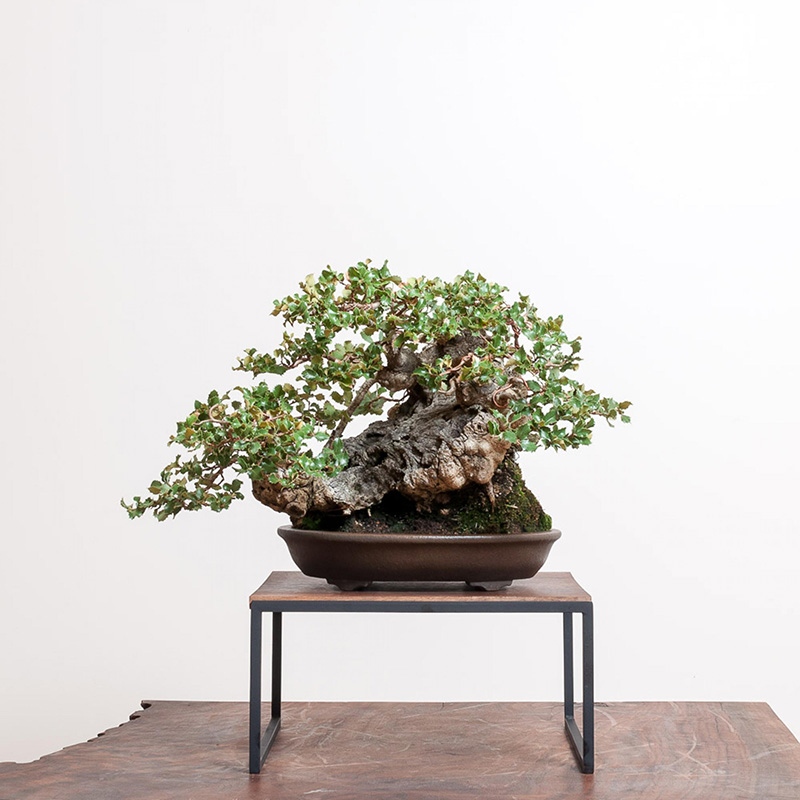
Coast Live Oak Bonsai Inspiration


General Information
Coast live oak—Quercus agrifolia—is an iconic coastal species along the Pacific coastline of North America.
As one of the most interesting oak species in the world to be used as bonsai, this broadleaf evergreen never fully defoliates. It maintains its foliar mass and boasts a thick, rigid, spiny leaf as its main identifier.
Because coast live oak grows in the Mediterranean belt of the Pacific coastline of California, it has characteristics that prevent transpiration within its aesthetics.

Caring for Coast Live Oak Bonsai

Watering
Coast live oak is a moderate water mobility tree, meaning it needs to dry out between waterings—contrary to most broadleaf trees. Due to the thicker, rigid leaf and reduced transpiration, oxygen must be allowed back into the system before being thoroughly hydrated again.

Sun Exposure
Because coast live oak grows in the Mediterranean climate in California, it loves heat and can grow in incredibly hot, dry conditions.
When kept in a deeper container that has a reservoir of water, full sun exposure will create tight inner nodes, small leaves, and a strong tree that is very responsive to bonsai operations.

Temperature
Coast live oak bonsai is capable of tolerating heat in excess of 100 °F as long as it lives in a deeper container that can facilitate the root system.
Coast live oak does not tolerate freezing temperatures when in a bonsai container. The smaller the container, the more susceptible it is, but the general rule is to not let your coast live oak bonsai freeze.
In a native region, you may experience a light frost, but never significant freezing. You should still protect your tree from temperatures when possible.

Fertilizing
When fertilizing coast live oak bonsai, avoid high nitrogen fertilizers. Opt instead for a solid fertilizer once per month or a liquid fertilizer once per week during the growing season.

Pruning
The best time for structural pruning and branching of coast live oak bonsai is in the spring, prior to growth. You can come back to pruning in midsummer after the tree has had time to produce a strong flush of growth and has built up a lot of energy.
Coast live oak can produce a second flush of growth toward the end of July to mid-August, but you want to avoid any heavy reduction of foliar mass or branching as you get closer to fall.
Without the foliar mass or the leaf to create the resources it needs, the tree cannot grow strong for the following year.
Refinement pruning and partial defoliation require you to prune back the elongated shoots to two active present buds and reduce the remaining leaf surface by two-thirds. This will stimulate ramification.

Repotting
Coast live oak bonsai can have a variety of soil circumstances when repotting, depending on how much control you have over your watering.
You may use a solid akadama soil or a 3-1-1 akadama, pumice, and lava mix as long as you can customize your watering schedule.
But if you’re using an automatic irrigation system, a 1-1-1 akadama, pumice, and lava mix is the driest mix you would want to use. For an increased capacity to produce finer ramification, you can use a 2-1-1 mix to provide the tree with more resources.
When repotting coast live oak, you never want to bare root or heavily reduce the sheen at any one time. The focus should remain on ensuring the health of the soil and the sheen. Sheen base trees thrive in deeper containers.

Propagation
Three ways to propagate your coast live oak bonsai are through:
● Air layering
● Cuttings; and
● Acorns
However, acorns tend to produce many genetic variations and can mutate considerably, making it impossible to predict the outcome.

Pests/Disease
Coast live oak bonsai suffer from a variety of pathogens, however, the main concern with this tree is sudden oak death—phytophthora ramorum—a root-borne pathogen that can be very challenging.
Cynipid gall wasps are a common but not overly damaging pest known to live on coastal live oak trees. The main damage caused by the wasps is leaf scorching.
The wasps die naturally from parasites, fungi, competing insects, and predators that live within the galls.
Spider mites can also be found on the bottom side of the leaf and can usually be removed with a good blast of water.
Buying Information
Coast Live Oak Bonsai FAQS
No, the gall wasp may cause leaf scorching, which can be unsightly, but it does not harm the tree.
If your coast live oak bonsai lives in a container, you should not let it dry out to the degree it would in the natural environment. You want to allow your tree to dry out between waterings to allow more oxygen into the system, but if kept excessively dry while containerized, it can experience significant health issues.
Like many broadleaf evergreen trees, coast live oak has drier tissue inside its physiological system. It tends to move less water with its thicker cuticle and drought-resistant leaf, and as a result, the tissue is not as hydrated and malleable.
Because of its physiology, the leaves can split and tear quite easily. The young, vigorous branches tend to have a tremendous amount of flexibility, and you can see the exterior tissue wrinkle or split, revealing green underneath.
Older branches form a stronger, structural wood that can also become brittle and capable of breaking in the styling process.


